FOR INTERNATIONAL ORDERS – PLEASE EMAIL SALES@LOADEDBIKES.CO.UK SO WE CAN CHECK SHIPPING COSTS FOR YOUR ORDER AND PROVIDE YOU WITH A QUOTE
Guide to Bicycle Fork Mounts and Axle Sizes to ensure the correct fit!
Here’s our quick guide to Bicycle Fork Mounts and Axle Sizes to ensure the correct fit for your bike
Q1. How can I identify my bike’s axle type and size? A1. Look for Manufacturer Markings
The easiest way to identify your axle standard is to check for labels provided by the manufacturer:
Fork Stickers: Some manufacturers place a sticker on the fork leg that explicitly states the axle width, such as “Boost” or “110mm”.
Axle Printing: The dimensions (diameter and width) are often printed or engraved directly onto the axle itself.
Perform Manual Measurements
If there are no markings, you can use a ruler or tape measure to find the dimensions:
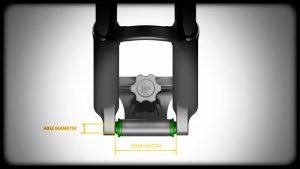
Diameter: Measure across the circular end of the axle. For example, a common mountain bike axle diameter is 15mm. Modern road and gravel bikes with disc brakes are often 12mm, while traditional quick-release axles are much skinnier at 5mm.
Width (Spacing): Measure the distance between the inside of the fork dropouts. Common widths include 100mm for road/gravel bikes and older mountain bikes, with many modern mountain bikes being 110mm wide.
Identify the Type by Design
Different styles of bikes often use specific standards:
Quick Release (QR): Traditional or older road bikes typically use a 5×100 mm QR axle. These are easily identified by C-shaped lugs (dropouts) at the bottom of the fork; once you loosen the axle, the wheel “drops out” of the frame.
Thru-Axles: Modern gravel, road, mountain bikes and e-bikes often use thru-axles, with 12x100mm and 15x110mm being a common standards.
RockShox Torque Hubs: If you have RockShox forks newer than 2016, you may have a “torque hub” variation of the 15x110mm axle. You can identify this by looking at the inside of the dropouts for a large recessed “spot face” about the size of a two-pound coin. These require specific spacers to ensure the fork aligns easily when the wheel is installed.
Q2. What are the main differences between fork mount adapter types? The main differences between fork mount adapter types are determined by the axle diameter, the spacing width of the fork, and the specific design of the fork’s dropouts.
The primary differences include:
A2. Quick Release (QR) vs. Thru-Axle Adapters
Adapters are first categorised by the fundamental style of the bike’s axle system:
5x100mm QR Adaptors: These are designed for traditional, “skinny” axles (5mm diameter) and forks with C-shaped lugs. In this setup, the wheel literally “drops out” once the axle is loosened.
9x100mm Adaptors: These are usually found on smaller framed/children’s bikes, or lower spec’d mountain bikes. This axle standard can feature on bicycle forks with both C-shaped lugs and with a thru-axle design
12x100mm Thru-Axle Adaptors: These are common for modern road and gravel bikes with disc brakes
15×110 mm Thru-Axle Adaptors: These are common for modern mountain bikes and e-bikes. These adapters accommodate a much thicker 15mm diameter axle and a wider 110mm spacing between the fork legs.
Standard vs. Torque Hub Axles
Even when the axle dimensions are the same (such as 15×110 mm), the physical interface of the fork can require different adapter shapes:
Standard Adaptors: These are used for most modern mountain bike forks (like those from Fox) where the circular “spot face” on the inside of the fork legs is only slightly larger than the diameter of the axle.
Torque Spacers: These are specifically designed for RockShox forks manufactured after 2016. These forks accommodate a “torque hub” design for added stiffness, which has a large, recessed circular area (a “spot face”) about the size of a two-pound coin on the inside of the dropout, which the hub or fork mount adaptor nestles into.
The Key Difference: While a standard adapter will work, torque-specific adapters are designed to sit within that recessed spot face. This ensures the axle holes of the forks are automatically aligned to the hub or fork mount, so you don’t have to manually line the holes up or wiggle the axle into place.
Q3. How to Choose the Correct Adapter for Your Fork Mount?
A3. To differentiate which adapter type you need, you can look for:
Manufacturer Markings: Check for stickers on the fork leg or dimensions printed directly on the axle.
Physical Measurements: Use a ruler to check the diameter of the axle (e.g., 5mm vs. 15mm) and the width between the fork dropouts (e.g., 100mm vs. 110mm).
Visual Inspection: Look inside your fork dropouts. If you see a large, recessed circular notch, you likely require a torque hub adapter rather than a standard one
Q4. Explain the unique requirements for modern RockShox forks for torque hub.
A4. Modern RockShox forks manufactured after 2016 often feature a specific variation of the standard 15x110mm axle known as a torque hub. These forks are distinguished by a larger “spot face” on the inside of the dropouts, which is a recessed circular area approximately the size of a two-pound coin. The primary benefit of this was to create a more rigid connection between the forks and the front wheel, reducing twist and lateral flex in the fork lowers, particularly during hard cornering, breaking, and riding in rough terrain. Because of this unique physical design, they require specialised torque adaptors shaped to fit exactly within the recessed notch. This ensures that you do not have to manually wiggle or position the forks to get the axle through, making the installation process much simpler than with standard adaptors.
Q5. Can I use these fork mounts for road and mountain bikes? A5. Yes, you can use these fork mounts for both road and mountain bikes, provided you use the correct fork mount adaptors or spacers for each bike’s specific axle type.
Here is how the mounts accommodate both styles:
Interchangeable adaptors: The fork mount is designed to be universal; the “Fork Bracket” itself remains the same, but the adaptor type varies based on your selection at the time of purchase.
Road and Gravel Bikes: These typically use 12x100mm Thru-Axle for bikes with disc brakes, whereas older, more traditional road bikes are usually 5x110mm Quick Release (QR) adapters, which are designed for the traditional skinny axles and C-shaped dropouts.
Mountain Bikes: Modern mountain bikes usually require 15x110mm Thru-Axle adapters. If you have a modern RockShox fork (2016 or newer), you may require torque spacers to fit the recessed “spot face” on those forks.
Mixed Loading: Because the fork mounts feature 360-degree rotation and a built-in offset, you can easily stagger different types of bikes without their handlebars clashing, such as mountain bikes with different fork travel, or a mountain bike and a road bike side by side.
When loading, just keep in mind that some bikes may be more sensitive to extreme rotation angles than “slacker” mountain bikes.
Q6. Are these fork mounts suitable for e-bikes with thru-axles? A6. Yes, these fork mounts are suitable for e-bikes with thru-axles, provided you use the correct spacers for your specific axle dimensions.
The suitability for e-bikes is supported by several factors:
Interchangeable Spacers: Whilst the fork bracket itself is standard, the spacer type varies depending on your choice at purchase. E-bikes commonly use 15x110mm thru-axles, and there are specific adapters available to accommodate this standard.
Support for Long/Slack Bikes: E-bikes often have longer wheelbases and “slacker” geometry. The loading guide notes that longer wheelbases or slacker bikes are generally more stable and can handle steeper rotation angles of the fork mount than shorter bikes.
Heavy-Duty Design: E-bikes are often heavier; these fork mounts have been designed to hold bikes weighing up to 26kg and have been designed to withstand a 30mph impact whilst carrying that load.
Space Optimisation: Because e-bikes are often larger, the fork mounts’ built-in offset and 360-degree rotation are particularly beneficial. These features allow you to stagger heavy e-bikes to prevent handlebars from clashing without having to loosen headsets or move the bikes manually.
When loading an e-bike, ensure you check that the back wheel remains on the floor and the bike does not lean excessively if you choose to rotate the mount to save space
Q7. Will my bike lean if I rotate the fork mount?
A7. Whether your bike will lean depends on the angle of rotation and your bike’s wheelbase length or slackness . While the fork mount can rotate a full 360 degrees to help stagger multiple bikes, rotating it too far can compromise stability.
Here is what you need to consider:
Wheelbase Length: Shorter-wheelbase bikes are more prone to leaning or to their rear wheel lifting off the floor if the fork mount is rotated at an extreme angle. Longer, or “slacker,” bikes are generally more stable and can handle greater fork mount rotation angles.
Maximum Rotation: The maximum safe rotation for a fork mount varies by bike.
Warning Signs: You should check that, once the bike is mounted, it does not lean and that the back wheel has not lifted.
The Solution: If you notice your bike leaning or the rear wheel lifting, reduce the fork mount’s rotation by one increment and check the position again.
For most setups, positioning the bike either parallel to the rail or at a slight offset angle is a universal configuration that works for the majority of bikes
Q8. How does the 360-degree rotation help with van space?
A8. The 360-degree rotation feature of the fork mount helps optimise van space primarily by allowing you to stagger multiple bikes closely together without needing to adjust the bikes’ handlebars or headsets. This rotation provides several specific space-saving benefits:
Handlebar Clearance: Because the rotation happens at the base of the fork mount, you can pivot the bikes to different angles so that the handlebars do not clash. This eliminates the need to loosen the headset or manually rotate the bars to fit the bikes side by side.
Reduced Floor Footprint: By rotating the fork mounts and utilising their built-in offset, you can place bikes very close together. This leaves more open floor space for other “kit and equipment” or additional bikes that would otherwise be occupied by a wider bike arrangement.
Flexible Staggering: The fork mount features a special spline on the underside that allows it to pivot to any angle. This allows you to stagger bikes along a rail in a way that best fits the specific dimensions of your van and your gear, rather than being restricted to a fixed, parallel position.
Customisable for Different Wheelbases: Rotation can be adjusted to suit the bike type. For instance, longer or “slacker” bikes can often handle steeper rotation angles, allowing for even more aggressive space-saving configurations, while shorter bikes can be set to a more moderate angle to maintain stability.
By using this rotation in conjunction with the fork mount’s ability to be flipped 180 degrees, you can achieve a very tight packing density for transport without the “Tetris®” struggle often associated with loading multiple bikes into a van
Q9. What is the benefit of the built-in offset?
A9. The primary benefit of the built-in offset in the Loaded Bikes fork mount is that it allows you to optimise floor space by packing multiple bikes very close together without needing to physically stagger the mounts on the floor. The specific advantages include:
180-Degree Flipping: Because of the built-in offset, you can flip one mount 180 degrees relative to another. This allows you to drop a second bike onto the adaptors, using significantly less floor space than traditional setups.
Increased Storage Space: By using this offset to tighten the packing density of the bikes, you leave more of the van floor open for other kit, equipment, or additional bikes.
No Manual Staggering Required: Unlike other systems that require bolting mounts to the floor at different depths to prevent handlebars from clashing, the offset design handles this spacing for you.
This feature works in tandem with the mount’s 360-degree rotation (aided by a special spline on the underside), which allows you to stagger bikes along a rail without having to loosen headsets or rotate handlebars manually.