
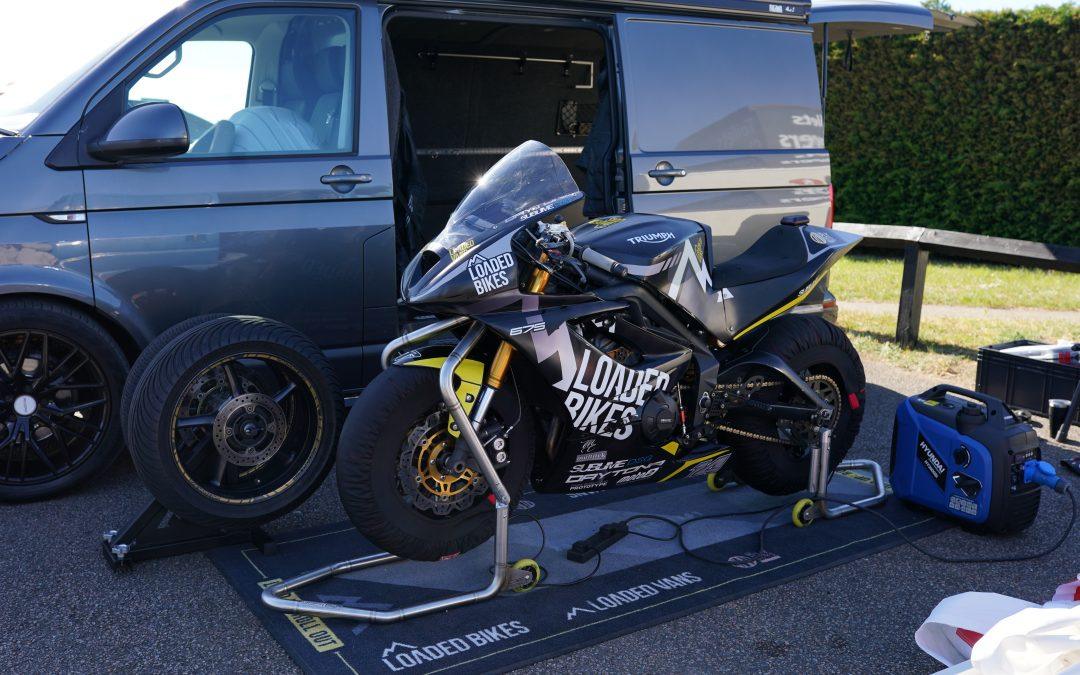
How to Load a Motorcycle in a Van
Quick answer: To load a motorcycle in a van, walk the bike up a ramp angled at least four times the height of the load bay lip, push the front wheel into a wheel chock to hold it upright, then secure it with soft loop straps at roughly 45 degrees on both sides of the handlebars plus a rear strap to stop fore-aft movement. A dedicated rack with a built-in wheel chock makes this far easier than relying on a van’s factory tie-down points.
A van is one of the easiest ways to transport a motorcycle without the hassle of a trailer, the cost of a courier, or the risk of riding a bike that isn’t road-legal, insured, or fit to ride. But “just wheel it up a ramp and shut the doors” is how bikes end up scratched, dented, or tipped over halfway down the motorway. Properly loading and securing a motorcycle for transport comes down to three things: getting it in safely, restraining it so it can’t move, and protecting both the bike and the van while you do it.
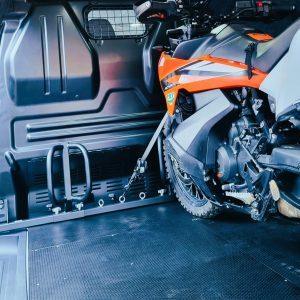
Before You Load: Check the Basics
Ramp angle and length. A short, steep ramp is harder to control than a long, shallow one. As a rule of thumb, your ramp should be at least four times the height of the load bay lip. If your van sits high, consider a folding aluminium ramp rather than improvising with whatever’s lying around the garage.
Weight and width. Most motorcycles will clear a standard panel van’s load bay, but check the width of your handlebars against the van’s rear doors and internal width, especially on smaller vans like a Caddy or Transit Connect. Also, check your van’s payload capacity. A loaded tourer or adventure bike can easily weigh 250kg+, and that’s before you add fuel, panniers, or a second bike.
Two pairs of hands. Loading solo is possible with a ramp and the bike’s own power or a winch, but having someone to spot you, especially at the top of the ramp where the bike transitions from incline to flat, makes the whole job safer and faster.
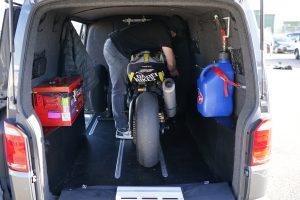
Getting the Bike In
- Position the van on flat, level ground with the handbrake on and ramp(s) securely hooked onto the load bay lip.
- Walk the bike up rather than riding it in, unless you’re experienced and the ramp is wide and grippy. First gear and gentle clutch control gives you the most precision.
- Keep your weight forward and over the bike as you push, so you’re guiding it rather than fighting its momentum.
- Aim straight for the wheel chock or your chosen tie-down point from the moment you start up the ramp, small corrections are much harder once you’re committed to the incline.
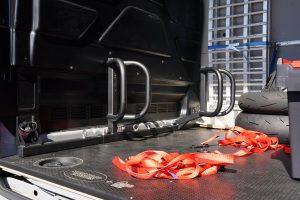
Securing the Bike: What Actually Stops It Moving
This is the part most people get wrong. A motorcycle has a tiny contact patch and a high centre of gravity, so even gentle braking or cornering forces can topple it if it isn’t restrained on at least two, ideally three, points. Improvising with whatever tie-down points happen to be in the van floor gets old fast, and rarely holds a bike as securely as you’d like.
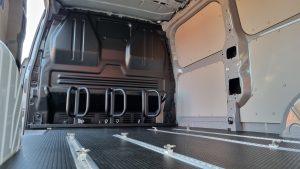
This is exactly what our Modular Bike Rack range is built for. It’s a motorbike van rack with a built-in wheel chock, fitted to the load bay floor and designed to take the guesswork out of loading and securing a motorcycle in a van.
Wheel chock. The front wheel is pushed into the rack’s wheel chock, which locates and supports the wheel so the bike stands upright on its own without you having to balance it while you strap it in. This is the part that does most of the work, everything else is there to back it up.
Tie-down points built in. The rack gives you proper, strong anchor points at the right height and angle for straps, rather than relying on low-down factory tie-downs that were never designed with a motorcycle in mind.
Soft loop straps then go around the handlebars (not the brake or clutch levers) or a sturdy part of the frame, down to the rack’s anchor points at roughly 45 degrees on both sides. This triangulates the bike and stops it from leaning left or right. A third strap from the rear of the bike back into the load bay stops fore-aft rocking under braking and acceleration.
Compress the suspension slightly when you tighten the straps. A little preload through the forks and shock keeps the bike planted and stops it bouncing on its suspension over bumps, which loosens straps over a long journey.
It’s a modular system, so the rack is available to fit a VW Transporter, VW Transporter Kombi, Transit Custom MK1, or VW T7 and Transit Custom MK2, so it bolts into your specific van rather than being a generic fit.
Protecting the Bike (and the Van)
A few extras make a real difference over a long trip:
- A padded mat at the threshold and load bay floor stops paint and panels from getting chipped on a bare metal lip or ply edge.
- Soft hooks or padded loops for your straps prevent rubbing on paintwork, levers, or cables where a strap meets the bike.
- Check your straps an hour into the journey. Suspension settles, and straps that felt tight at the kerb can loosen once the bike has had a chance to move with the road.
Got More Than One Bike?
Because the system is modular, you’re not limited to one bike per van. The rack range is designed to take multiple wheel chocks along the same floor fixing, so you can space bikes apart properly rather than wedging padding between them and hoping for the best. It also means you’re not relying on the van’s factory tie-down points, which were never positioned with motorcycles in mind.
Frequently Asked Questions
Can you transport a motorcycle in a van without a rack? Yes, but it’s harder to do safely. Without a wheel chock, you need a second person to hold the bike upright while you fit straps, and you’re reliant on whatever tie-down points the van has, which are rarely positioned at the right height or angle for a motorcycle.
How do you tie down a motorcycle in a van? Use soft loop straps around the handlebars or frame (never the brake or clutch levers), angled at roughly 45 degrees down to anchor points on both sides, plus a third strap from the rear of the bike to stop fore-aft rocking. Compress the suspension slightly when tightening so the bike doesn’t bounce loose over a long journey.
What ramp angle do you need to load a motorcycle into a van? As a rule of thumb, the ramp should be at least four times the height of the load bay lip. A long, shallow ramp is far easier to control than a short, steep one.
Is a wheel chock necessary to transport a motorcycle? It isn’t strictly necessary, but it makes the job significantly safer and faster, since it holds the bike upright on its own once the front wheel is in place, rather than you having to balance it while fitting straps.